
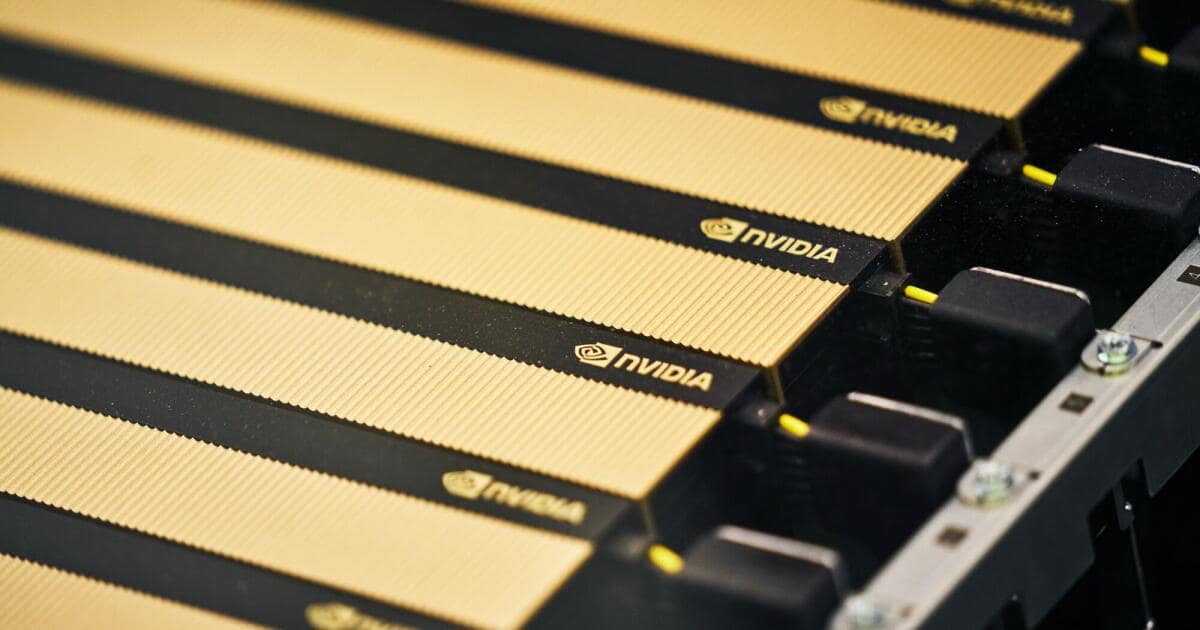
The meteoric rise of Nvidia Corp. — once the most valuable company in the world — has come to a sharp halt, with its stock now trading at levels not seen since before the AI boom began. In just two months, the chipmaker lost roughly $1 trillion in market value, sending its shares into a steep correction that has left investors rethinking their positions in the AI sector.
A Market Correction After the AI Boom
Nvidia’s GPUs have long been the backbone of artificial intelligence development, powering everything from large language models to autonomous vehicles. The company’s stock soared during 2023 and early 2024 as demand for its chips surged due to the rapid expansion of data centers and AI applications. However, recent months have seen a dramatic shift in investor sentiment.
The stock has fallen 16% since hitting an all-time high on May 14, with investors moving away from Nvidia toward other semiconductor companies, particularly those specializing in memory and storage technologies. This shift reflects a broader reallocation of capital within the AI sector as markets begin to price in more realistic expectations for growth.
The Valuation Gap: Cheaper Than the S&P 500
Nvidia’s current valuation is now lower than that of the S&P 500 Index, which trades at over 20 times forward earnings. Even the Nasdaq 100, a tech-heavy index, is priced at nearly 23 times earnings. This means that Nvidia, once seen as an unstoppable force in AI, is now trading at a discount compared to some of its peers.
Despite this, Wall Street analysts remain optimistic about the company’s future. Many have raised their profit estimates for the coming quarters, citing strong demand for data center hardware and continued innovation in AI applications. However, the stock’s current price suggests that investors are no longer placing the same level of confidence in Nvidia as they did during its peak.
The Shift to Memory and Storage
The selloff has also benefited companies like Micron Technology Inc., which specializes in high-bandwidth memory chips. These components are essential for AI training, and their prices have surged due to increased demand. Micron’s stock is up 229% this year, outperforming even some of the most successful tech stocks.
This shift highlights a broader trend within the semiconductor industry: as AI applications mature, the focus is moving from general-purpose GPUs to specialized hardware that can handle specific tasks more efficiently. Companies like AMD and Intel have also seen their shares rise significantly, indicating that investors are diversifying their bets across the sector.
A Consistent Performer at a Discount
Despite its current valuation, Nvidia remains one of the most profitable companies in the world. It is expected to deliver the fourth-fastest revenue growth in the S&P 500 this year, according to Bloomberg data. However, it is now cheaper than about half of the stocks in the index, including traditional industries like candy and utilities.
Randy Hare, director of equity research at Huntington Bank, argues that Nvidia’s current price reflects its strong historical performance and consistent profitability. “Stocks follow earnings,” he said. “It’s a consistent performer.”
The Semiconductor Index: A Mixed Bag
The Philadelphia Stock Exchange Semiconductor Index has seen a dramatic rise this year, with a 74% increase putting it on pace for its best year since 2003. However, Nvidia is not the top performer in this index — it ranks third-worst among the 30 semiconductor-related stocks.
This divergence underscores the growing disconnect between Nvidia and the broader chip market. Last month, Nvidia’s correlation to the semiconductor index dropped to its lowest level since 2014, according to Bloomberg data. This suggests that investors are no longer viewing the company as a proxy for the entire sector.
Competition from Within
One of the key factors holding back Nvidia’s stock price is competition from both traditional rivals and its own customers. Companies like AMD and Intel have made significant strides in AI hardware, while tech giants such as Alphabet Inc. and Amazon.com Inc. are increasingly developing their own custom chips to reduce reliance on third-party suppliers.
However, despite this competition, Nvidia still holds a dominant position in the server GPU market. According to Bloomberg Intelligence data, the company captured 97% of the market at the end of 2025 — up from 95% at the end of 2024. This suggests that demand for its hardware remains strong, even as investors begin to diversify their bets.
Analysts Remain Bullish
Despite the recent selloff, Wall Street analysts remain bullish on Nvidia’s long-term prospects. Of the 82 analysts tracking the stock, only three have issued hold ratings and one recommends selling. The average price target of $302 implies a potential gain of over 50% in the next year — the highest among the so-called Magnificent Seven tech giants.
This optimism is partly based on Nvidia’s ability to navigate past periods of market contraction. Michael Bailey, director of research at Fulton Breakefield Broenniman, notes that the company has historically shown resilience during downturns. “It’s been a rough run but we’ve seen that before and we’ve seen pretty rapid compression and a pretty rapid recovery,” he said.
Interesting Reads
Conclusion
Nvidia’s recent stock performance reflects a broader shift in investor sentiment within the AI sector. While its valuation is now at levels not seen since before the AI boom, the company remains a leader in data center hardware and continues to deliver strong revenue growth. The selloff has benefited other semiconductor companies, particularly those specializing in memory and storage, but it also highlights the growing diversity of the tech landscape.
For investors, the key question is whether Nvidia’s current price represents an opportunity or a warning sign. With analysts still bullish on its long-term prospects and the company maintaining its dominant position in the server GPU market, there may be room for recovery. However, the broader AI sector is evolving rapidly, and those who bet on the future of specialized hardware may find more value elsewhere.
As the semiconductor industry continues to evolve, investors should keep an eye on how Nvidia navigates this new landscape — and whether its stock will eventually return to its former heights.
Original Source
This article is based on publicly available reporting. For the complete original story, visit the publisher’s article.
Leave a Reply