
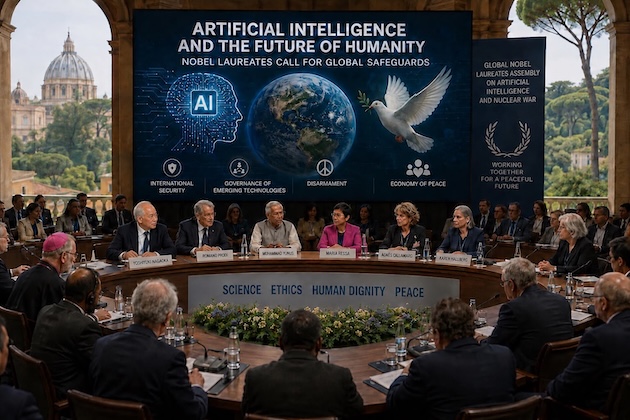
Artificial intelligence (AI) has become a defining force in shaping modern society, influencing everything from healthcare to warfare. Yet as its capabilities grow, so too do concerns about its potential risks. In a landmark event held at Borgo Laudato Si’ near Castel Gandolfo, more than 200 international leaders convened to address the urgent need for global safeguards against AI’s unchecked development. The gathering, organized by the Global Nobel Laureates Assembly on Artificial Intelligence and Nuclear War, brought together scientists, policymakers, and human rights advocates to explore how AI could either strengthen or destabilize global peace.
A Call for Governance in an Age of Uncertainty
The conference was framed around a central question: How can humanity ensure that artificial intelligence remains a tool for progress rather than a threat to its own survival? The discussions highlighted the growing integration of AI into military systems, which has raised alarms about increased risks of cyber warfare, proliferation, and high-intensity conflicts. These developments have made it clear that regulating AI is no longer optional—it is imperative.
Participants emphasized that while AI offers immense potential for innovation in fields like medicine and environmental monitoring, its use in nuclear weapons systems could lead to dangerous uncertainties. Karen Hallberg, a physicist and president of the Pugwash Conferences on Science and World Affairs, warned that AI’s dual-use nature—much like nuclear energy—means it can be both a blessing and a curse.
The Human Element: Responsibility and Judgment
One of the most compelling arguments presented was not about the technology itself, but about how humans choose to use it. Yoshiyuki Nagaoka, President of the Ikeda Center for Peace, Learning, and Dialogue, argued that AI is not inherently dangerous; rather, its impact depends on human values and choices.
He stressed that younger generations are growing up in an increasingly digital world where machines are becoming trusted advisors at critical life moments. This shift raises important questions about how society should balance technological reliance with the preservation of human judgment. Naga, as he was often called, urged participants to reflect on the importance of education and critical thinking in ensuring AI remains a tool for empowerment rather than control.
Democracy Under Threat: The Role of AI in Society
Maria Ressa, the 2021 Nobel Peace Prize laureate, brought attention to how AI is reshaping democratic processes. She warned that the technology’s ability to spread disinformation at an unprecedented scale threatens the very foundations of free speech and public trust.
Ressa pointed out that AI-driven algorithms can manipulate public opinion on a massive scale, often without transparency or accountability. This has led to growing concerns about the concentration of power in the hands of a few tech giants, which she argued undermines democratic participation and civic engagement.
Economic Inequality and the Future of Work
The conference also turned its attention to the economic implications of AI. Muhammad Yunus, the 2006 Nobel Peace Prize laureate and founder of Grameen Bank, offered a deeply humanist critique of how AI could exacerbate existing inequalities.
Yunus argued that while AI may replace certain jobs, the real danger lies in its potential to deepen wealth concentration. He warned that if left unchecked, AI could reinforce an economic model where a handful of corporations control data and income, leaving many people without livelihoods or dignity.
His message was clear: AI should not be used as a tool for power consolidation but rather as a means to promote participation, entrepreneurship, and shared opportunity. For Yunus, the future must be one in which technology serves humanity, not the other way around.
The Path Forward: A Shared Responsibility
As the conference drew to a close, it became evident that no single nation or institution can address the challenges of AI alone. The discussions underscored the need for international cooperation, transparent governance frameworks, and ethical guidelines that prioritize human well-being over profit or power.
Participants called on governments to apply the precautionary principle—acting decisively before technology outpaces regulation. They also emphasized the importance of public education and critical engagement with AI, ensuring that individuals are equipped to make informed decisions about its use in their lives.
Interesting Reads
Conclusion
The gathering at Borgo Laudato Si’ marked a pivotal moment in the global conversation about artificial intelligence. It highlighted both the immense potential and the profound risks associated with this transformative technology. While AI is not inherently dangerous, its impact depends on how it is governed and used by society as a whole.
As we move forward, the key challenge will be to ensure that AI remains a force for good—one that enhances human capabilities rather than replacing them. This requires vigilance, collaboration, and a commitment to ethical principles that prioritize peace, justice, and the dignity of every individual.
Readers should watch closely for upcoming international agreements on AI governance, as well as continued efforts by civil society to shape the technology’s future in ways that align with human values. The path ahead is uncertain, but one thing is clear: the responsibility to guide AI lies not with machines, but with us.
Original Source
This article is based on publicly available reporting. For the complete original story, visit the publisher’s article.
Leave a Reply