
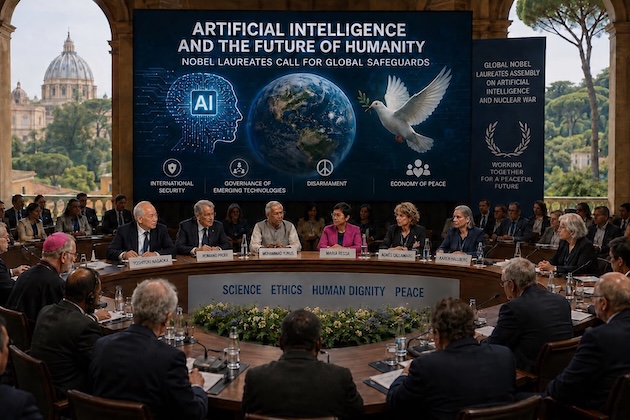
Artificial intelligence (AI) has long been a subject of both fascination and fear. From its early conceptualizations in science fiction to its current integration into nearly every aspect of modern life, AI continues to shape our world in profound ways. Yet as its capabilities grow, so too do the concerns about its potential misuse. In recent years, global leaders, scientists, and policymakers have increasingly called for international cooperation to ensure that AI development aligns with human values and promotes peace rather than conflict.
The latest developments in this ongoing debate took place at a high-profile conference held in Borgo Laudato Si’, near Castel Gandolfo, Italy. Organized by the Global Nobel Laureates Assembly on Artificial Intelligence and Nuclear War, the event brought together over 200 international figures to discuss the future of AI governance, disarmament, and global security.
A Growing Concern for Global Stability
The conference was convened in response to a pressing question: How can humanity ensure that AI remains a force for good rather than a threat? The discussions highlighted the increasing integration of artificial intelligence into military systems, which has raised alarms about the risks of cyber warfare, proliferation, and high-intensity conflicts. These developments have led many experts to argue that without proper regulation, AI could undermine global stability and erode ethical principles.
Participants emphasized that while AI offers immense potential for scientific advancement, medical breakthroughs, and economic growth, it also carries significant dangers if misused or poorly regulated. The central theme of the conference was clear: safeguarding AI is not just a technological challenge but a moral imperative.
Dual-Use Technology with Global Implications
One of the most pressing concerns raised during the discussions was the dual nature of AI as both a tool for progress and a potential weapon. Karen Hallberg, an Argentine physicist and president of the Pugwash Conferences on Science and World Affairs, drew a direct parallel between AI and nuclear energy. Just as nuclear fission has led to advancements in medicine and energy production while also enabling the creation of atomic weapons, AI presents similar risks.
Hallberg warned that the integration of AI into nuclear weapon systems could introduce dangerous uncertainties. For instance, algorithms might be used to analyze satellite imagery or interpret military situations, potentially leading to irreversible decisions with catastrophic consequences for humanity. She called on governments to apply the precautionary principle and act before technology outpaces political regulation.
The Human Element in AI Governance
While some speakers focused on the technical and geopolitical risks of AI, others emphasized the importance of human responsibility in its development and use. Yoshiyuki Nagaoka, President of the Ikeda Center for Peace, Learning, and Dialogue, argued that the real danger lies not in AI itself but in how humanity chooses to wield it.
Nagaoka stressed that the future of AI depends on whether society becomes more selfish or more compassionate. He called for greater emphasis on education and critical thinking as essential safeguards against the influence of AI on both individual and collective decision-making. His message was particularly poignant when he shared a story about an 86-year-old Japanese woman who turned to ChatGPT rather than her family for guidance in making a difficult life choice.
This example underscores a broader concern: as digital tools become more integrated into daily life, they may increasingly shape the ways people make decisions, often without adequate human oversight. Naga and others argue that preserving our capacity for judgment is essential to ensuring AI remains a tool rather than a master.
Democracy at Risk from AI
Maria Ressa, winner of the 2021 Nobel Peace Prize for her work in defending freedom of expression, raised alarms about the impact of AI on democratic societies. She warned that the spread of false information and large-scale manipulation of public opinion are among the most significant threats posed by artificial intelligence.
Ressa emphasized that AI is not just a technological issue—it is a fundamental challenge to the functioning of democracy itself. As algorithms increasingly influence political discourse, she called for greater transparency and accountability in how these systems operate. Her message resonated with many participants who shared her concerns about the concentration of power among a small number of technology companies.
Economic Inequality and the AI Divide
Perhaps the most radical critique came from Muhammad Yunus, Nobel Peace Prize laureate and founder of the Grameen Bank. Yunus shifted the focus to economic inequality, arguing that the real danger of AI is not just its potential for misuse but also its role in reinforcing existing power imbalances.
He warned that AI could deepen the concentration of wealth and exclude large segments of the population from economic participation. In a system where a few companies control data and technology, he argued, many people risk losing their livelihoods, dignity, and independence. Yunus called for an economy based on participation, entrepreneurship, and shared opportunity rather than one dominated by AI-driven automation.
A Call to Action
As the conference drew to a close, one message was clear: there is no turning back from the age of artificial intelligence. It has become an integral part of our world, and its impact will only grow in the coming years. The challenge now lies not in rejecting AI but in ensuring it serves humanity rather than undermines it.
The participants agreed that without global cooperation, the risks of AI misuse could escalate beyond control. They called for a new era of governance—one grounded in transparency, accountability, and ethical responsibility. As Karen Hallberg put it: “I am not afraid; I am concerned. And it is precisely this concern that should give us the determination to act before it is too late.”
Interesting Reads
Conclusion
The discussions at the Global Nobel Laureates Assembly on Artificial Intelligence and Nuclear War underscored a critical truth: AI is no longer just a technological innovation—it is a defining force shaping our future. While its potential for good is vast, so too are the risks if left unchecked.
As we move forward, it will be essential to address both the technical and ethical dimensions of AI governance. This includes establishing international frameworks for regulation, ensuring transparency in algorithmic decision-making, and promoting education that fosters critical thinking and human judgment.
Readers should watch closely for developments in global AI policy, particularly as major nations begin to draft comprehensive regulations and multilateral agreements on technology use. The next few years will be crucial in determining whether AI becomes a tool for peace or a source of conflict. What is clear is this: the future of humanity depends not just on what we build with AI—but how we choose to use it.
Original Source
This article is based on publicly available reporting. For the complete original story, visit the publisher’s article.
Leave a Reply