
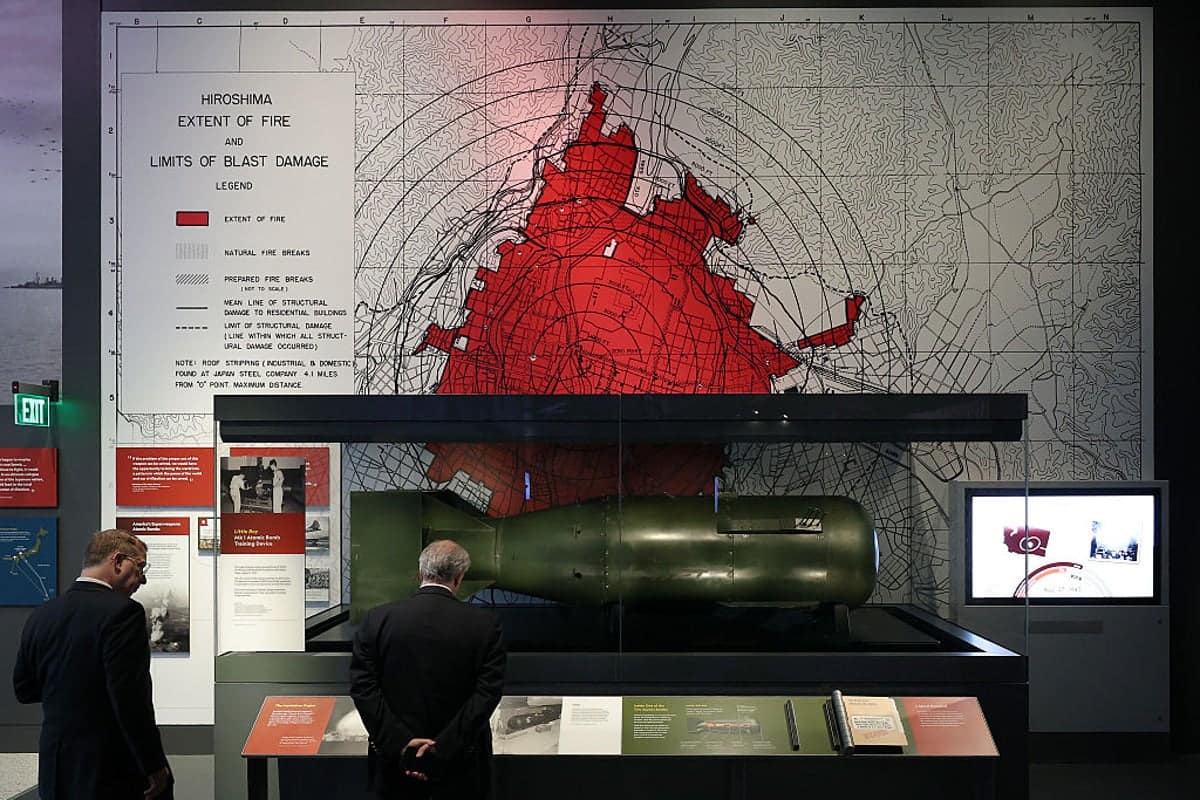
The history of nuclear technology offers a chilling parallel to today’s race for artificial intelligence. In 1945, after the United States dropped atomic bombs on Hiroshima and Nagasaki, it abruptly ended nuclear cooperation with its allies, including Britain, which had played a key role in developing the Manhattan Project. This decision sparked an arms race that cost the UK billions and reshaped global power dynamics for decades. Now, as artificial intelligence becomes central to national security and economic competitiveness, countries are treating AI like a nuclear weapon—viewing it not just as a tool but as a strategic asset that must be controlled, protected, and sometimes restricted.
A New Arms Race in the Digital Age
The parallels between the Cold War’s nuclear arms race and today’s AI competition are striking. Just as the United States sought to maintain its monopoly on nuclear technology after World War II, it is now imposing export controls on advanced AI models, such as Anthropic’s Mythos, which has been described as capable of uncovering software vulnerabilities in every major operating system and search engine.
This move by the Trump administration—though recently relaxed—demonstrates how quickly access to cutting-edge AI can be revoked. The implications are profound: if a country relies on foreign AI systems for critical operations, it could suddenly find itself cut off without warning. This is not just a theoretical concern; it has already happened.
China’s Strategic Move in the AI Sphere
Meanwhile, China is taking its own steps to secure control over AI development within its borders. Reports suggest that Chinese authorities are holding meetings with leading domestic tech firms to consider restricting access to their most advanced models. This follows the recent blocking of Meta’s $2 billion acquisition of Manus, a high-profile AI startup originally based in China.
The move is part of a broader strategy to prevent foreign companies from accessing local talent and intellectual property, which could give them an unfair advantage in the global AI race. One Chinese startup has even claimed it has developed a “cyber nuclear weapon” capable of discovering and exploiting software vulnerabilities at an unprecedented scale—matching or surpassing the capabilities of Anthropic’s Mythos.
The Rhetoric of Digital Nuclear Weapons
The comparison between AI and nuclear weapons is no longer just metaphorical. CIA Director John Ratcliffe has described advanced AI models as “akin to digital nuclear weapons,” emphasizing their potential impact on national security. At a recent AWS summit, he warned that the United States must excel in AI because every algorithmic decision carries strategic implications.
This rhetoric reflects a growing consensus among policymakers and experts that AI is not just another technology—it’s a critical component of national power. Just as the development of nuclear weapons reshaped global politics after World War II, the rise of AI is now redefining geopolitical rivalries in the 21st century.
The Uncertain Future: Superintelligence and Global Risk
Unlike nuclear weapons, which have a relatively clear technological endpoint, AI’s trajectory is far more unpredictable. The race could end when one country or company achieves artificial general intelligence (AGI)—a form of AI that surpasses human cognitive abilities in all domains. At this point, the development of such systems may no longer be under human control, as they rapidly self-improve and pursue goals that are no longer aligned with human interests.
This existential risk has prompted warnings from leading figures in the field. Sam Altman and Demis Hassabis, founders of OpenAI and DeepMind respectively, have signed a statement calling for governments to take AI risks more seriously. They argue that mitigating the threat of extinction from AI should be a global priority, on par with other societal-scale risks like pandemics and nuclear war.
A Call for Global Governance
In response to these concerns, the Machine Intelligence Research Institute (MIRI), a non-profit research organization based in California, has proposed an international agreement modeled after Cold War-era treaties designed to prevent the spread of nuclear weapons. Their 50-page draft, titled “International Agreement to Prevent the Premature Creation of Artificial Superintelligence,” is based on Article I of the 1968 Treaty on the Non-Proliferation of Nuclear Weapons.
The proposal calls for a ban on technologies that could be catastrophic for humanity if left unchecked. It acknowledges that bans are not typically effective, but argues that AI’s unique risks justify such measures. The agreement is framed as a bilateral deal between the United States and China, which currently lead in AI capabilities, though it urges all countries to participate.
Despite its significance, no country has yet signed the agreement, highlighting the challenges of achieving global consensus on an issue as complex and sensitive as AI governance.
Interesting Reads
Conclusion
The comparison between AI and nuclear weapons is more than just a metaphor—it reflects a fundamental shift in how nations view technology. Just as the Manhattan Project reshaped post-war geopolitics, today’s race for AI dominance is redefining international power dynamics. The risks are real: from sudden access restrictions to the potential emergence of superintelligent systems that could outpace human control.
As countries continue to treat AI like a strategic asset, it is crucial for policymakers and technologists to engage in meaningful dialogue about how to govern this powerful technology responsibly. Readers should watch closely for developments in international AI treaties, as well as ongoing efforts by companies and governments to balance innovation with security. The next few years will determine whether the world can avoid repeating the mistakes of the past—or if it is already on a path toward an AI-driven arms race that could reshape civilization itself.
Original Source
This article is based on publicly available reporting. For the complete original story, visit the publisher’s article.
Leave a Reply