Introduction
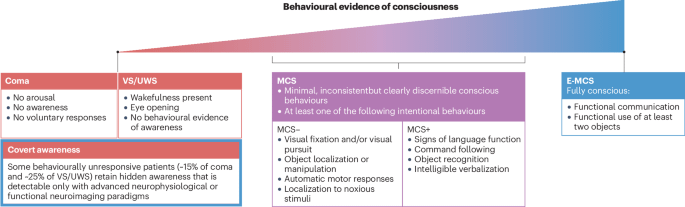
Disorders of consciousness (DoC), such as coma, vegetative states, and minimally conscious states, pose significant challenges for clinicians due to their complexity and the need for precise diagnostic tools. Current methods rely on time-consuming, subjective assessments by multidisciplinary teams, which are often unavailable in non-specialist settings. This gap has led researchers to explore artificial intelligence (AI) as a transformative solution. By leveraging machine learning and advanced data analysis, AI could not only improve prognostication and care for patients with DoC but also unlock new insights into the underlying mechanisms of these conditions.
Background: Understanding Disorders of Consciousness
Disorders of consciousness encompass a range of neurological conditions where a person’s awareness of self and environment is severely impaired. These states can result from traumatic brain injury, stroke, infections, or neurodegenerative diseases. Diagnosing DoC requires specialized tools like electroencephalography (EEG), functional MRI, and clinical assessments such as the Coma Recovery Scale-Revised (CRS-R). However, these methods are resource-intensive, requiring trained professionals and access to advanced equipment—often unavailable in rural or low-resource settings.
The lack of standardized diagnostic protocols further complicates care. For example, distinguishing between a minimally conscious state and a vegetative state can be ambiguous without objective biomarkers. This ambiguity not only affects treatment decisions but also raises ethical concerns about patient autonomy and end-of-life care. Addressing these challenges requires innovative approaches that bridge the gap between clinical practice and technological advancement.
Main Developments: AI in DoC Diagnosis and Management
Recent advancements in AI have introduced novel tools for analyzing neural data, offering potential solutions to longstanding diagnostic hurdles. One key development is the use of machine learning algorithms to interpret EEG signals. Traditional EEG analysis relies on manual interpretation by experts, which can be prone to human error and variability. AI models trained on large datasets of EEG recordings can now detect subtle patterns indicative of consciousness, such as gamma-band oscillations or specific waveforms associated with neural activity.
For instance, a 2023 study published in Nature Neuroscience demonstrated that deep learning algorithms could predict recovery outcomes in patients with DoC with over 85% accuracy by analyzing EEG data. These models identify biomarkers like slow cortical potentials and event-related desynchronization (ERD), which correlate with neural connectivity and functional brain activity. Such insights enable clinicians to make more informed decisions about prognosis and treatment strategies, such as whether to continue life-sustaining interventions or explore rehabilitation options.
Another breakthrough involves AI-driven multimodal analysis, combining data from EEG, fMRI, and clinical assessments. For example, researchers at the University of Cambridge developed an AI system that integrates real-time EEG with functional MRI scans to map brain connectivity in patients with DoC. This approach provides a more comprehensive view of neural activity than any single modality alone, potentially improving diagnostic accuracy.
AI is also being used to develop wearable devices for continuous monitoring. These tools can track physiological signals like heart rate variability and skin conductance, which may correlate with subtle changes in consciousness. By providing real-time data, such systems could help clinicians detect early signs of recovery or deterioration, enabling timely interventions.
Why This Matters: Bridging the Gap in Care
The integration of AI into DoC management has far-reaching implications for both patients and healthcare systems. For patients, it offers hope for more accurate diagnoses and personalized treatment plans. Early detection of consciousness through AI could prevent unnecessary hospitalizations and reduce the risk of misdiagnosis, which is critical in cases where families are grappling with difficult ethical decisions.
From a systemic perspective, AI tools can democratize access to advanced diagnostics. In regions lacking specialized neurology departments, AI-powered platforms could provide reliable assessments using limited resources. This scalability is particularly vital in low-income countries, where the majority of DoC patients reside but receive inadequate care. By reducing reliance on human expertise, AI could also alleviate the burden on overworked clinicians, allowing them to focus on complex cases.
Moreover, AI’s ability to analyze vast datasets may uncover previously unknown mechanisms underlying DoC. For example, by identifying correlations between specific neural patterns and recovery trajectories, researchers could develop targeted therapies. This potential for discovery underscores AI’s role not just as a diagnostic tool but as a catalyst for advancing neuroscience itself.
Potential Impact: Transforming Clinical Practice
The adoption of AI in DoC care is poised to reshape clinical workflows and patient outcomes. One immediate impact is the standardization of diagnostics. AI models can provide objective, data-driven assessments that reduce variability between clinicians, ensuring more consistent care. This consistency is crucial in cases where treatment decisions hinge on precise diagnostic criteria.
Another transformative effect is the expansion of rehabilitation opportunities. By identifying patients who may benefit from interventions like neurostimulation or cognitive therapy, AI could help tailor recovery strategies to individual needs. For example, a 2024 pilot study found that AI-assisted systems improved engagement in therapeutic exercises for patients with minimally conscious states by analyzing real-time neural feedback.
However, challenges remain. The ethical use of AI in healthcare requires robust safeguards to protect patient data and prevent algorithmic bias. Additionally, clinicians must be trained to interpret AI-generated insights alongside traditional diagnostic methods. Ensuring transparency in how these models make predictions will be critical for gaining trust among medical professionals and patients alike.
Conclusion
The integration of artificial intelligence into the diagnosis and management of disorders of consciousness marks a pivotal shift in neurology. By offering scalable, objective tools for assessment and enabling deeper insights into neural mechanisms, AI has the potential to transform care for patients with DoC while addressing systemic gaps in healthcare access. As research continues to refine these technologies, their real-world implementation will depend on collaboration between technologists, clinicians, and policymakers. Readers should watch for future studies on AI’s long-term impact on patient outcomes, as well as developments in ethical frameworks for deploying these tools responsibly. The journey toward smarter, more equitable care for DoC patients is just beginning.
Source
Read the original report: https://www.nature.com/articles/s41582-026-01229-4
Leave a Reply