
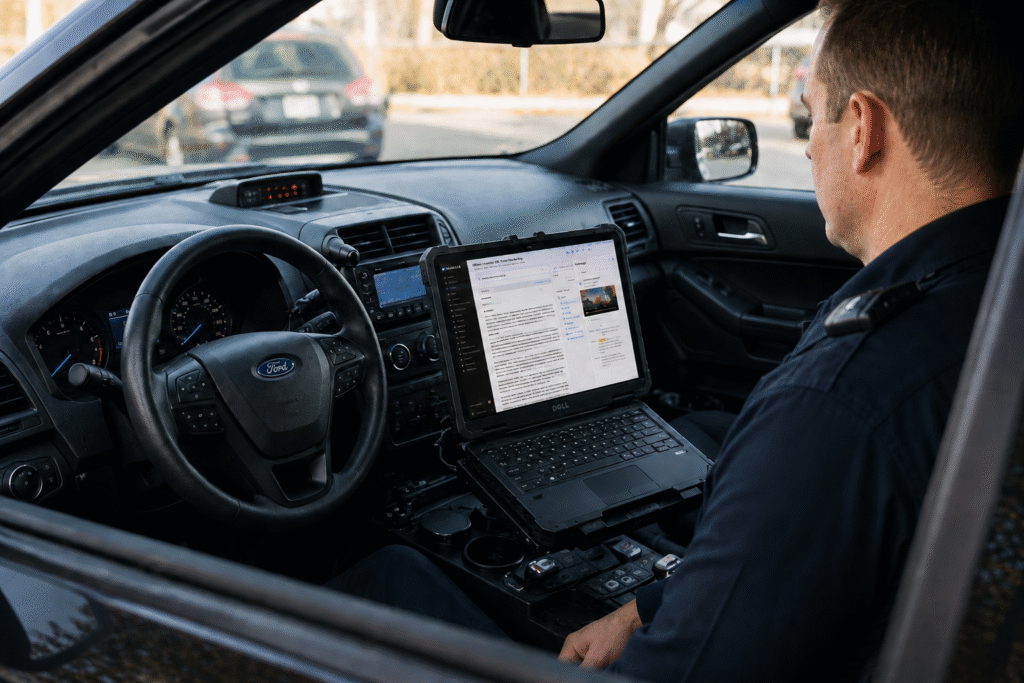
The integration of artificial intelligence (AI) into law enforcement is accelerating at an unprecedented pace, raising urgent questions about privacy, bias, and the balance between public safety and civil liberties. From facial recognition systems to predictive policing models and AI-assisted report writing, police departments across the United States are increasingly relying on automated tools to process vast amounts of data and make decisions that impact people’s lives. Yet, as these technologies become more sophisticated, so too do the concerns about their misuse, lack of transparency, and potential for reinforcing systemic inequalities.
The use of AI in policing is not new — law enforcement has long used data-driven tools such as automated license plate readers, video analytics, and predictive models to assist with investigations. What is different now is the scale, speed, and complexity of these systems. As police departments collect more digital evidence from body cameras, social media, and surveillance networks, AI is being deployed to help sort through this information faster than ever before.
This shift has sparked a growing debate among legal scholars, civil liberties advocates, and technology experts about how to regulate the use of AI in policing. While some argue that these tools can improve efficiency and reduce human error, others warn that they could be used to justify over-surveillance, introduce hidden biases into decision-making, and erode due process.
The Rise of AI-Powered Policing Tools
AI is now being embedded into a wide range of police operations, from surveillance to investigative work. Companies such as Axon, Motorola Solutions, TRULEO, Flock Safety, and Clearview AI are developing tools that can analyze body-worn camera footage, identify potential suspects through facial recognition, and even draft reports based on audio and video data.
One example is Mark43, a cloud-based software company serving over 300 law enforcement agencies. Its AI-powered tools include ReportAI, which helps officers draft police reports using information from dispatch records and body camera footage, and BriefAI, which summarizes case details for investigators and supervisors. These systems allow officers to focus more on community engagement and less on administrative tasks.
However, the use of such tools raises significant concerns. Critics argue that AI-generated outputs can be flawed — reflecting biases in training data or making errors in interpreting context. In some cases, these mistakes could lead to wrongful arrests, misidentification of suspects, or the misuse of sensitive information.
The Challenge of Regulation and Legal Oversight
As AI becomes more integrated into policing, law enforcement agencies are struggling to keep pace with the legal and ethical implications of their use. While a few states have enacted laws regulating the deployment of AI in public safety settings — such as California and Utah, which recently passed legislation requiring disclosure when generative AI is used in police report writing — there remains no consistent national framework.
This lack of regulation has led to concerns about transparency and accountability. Many AI systems operate in ways that are difficult for both the public and even law enforcement officers to fully understand. This opacity makes it challenging to challenge evidence in court or hold agencies accountable for decisions made by automated tools.
Legal scholars warn that without clear guidelines, the use of AI in policing could undermine constitutional protections such as privacy rights and due process. “There are very real constitutional, statutory and practical risks with this new model of agentic policing,” said Andrew Guthrie Ferguson, a law professor at George Washington University and author of Your Data Will Be Used Against You: Policing in the Age of Self-Surveillance.
The Risk of “Agentic Policing”
One of the most concerning developments is the emergence of what some experts call “agentic policing.” This refers to the use of AI systems that not only analyze data but also actively generate investigative leads, identify potential suspects, or suggest connections between cases. These tools can process vast amounts of information in real time and provide officers with recommendations based on patterns detected in historical data.
While proponents argue that such systems are designed to assist rather than replace human judgment, critics warn that they could shift the balance of power in policing. In a traditional investigative model, officers start with evidence and work toward conclusions. With agentic policing, AI might begin by generating potential suspects or leads before human investigators even have access to the data.
“This flips the traditional investigative process on its head,” said Ferguson. “We’ve never started with an answer and made people work backwards.”
This shift could make it harder for individuals to challenge decisions based on AI-generated evidence in court, as well as complicate efforts to hold law enforcement accountable for errors or biases introduced by automated systems.
Concerns Over Misuse and Surveillance
The potential for misuse of AI-powered policing tools has also become a major concern. In recent years, there have been several high-profile cases where police officers were accused of using these technologies for personal gain rather than public safety. For example, in April 2025, a former Costa Mesa, California, officer pleaded guilty to using law enforcement databases and Flock Safety cameras — which capture license plate information from passing vehicles — to monitor his wife, mistress, and romantic rivals.
Such incidents have led some communities to reconsider their use of automated license plate readers (ALPRs). At least 30 cities across the U.S. have ended or canceled contracts with ALPR providers since early 2025, citing concerns about surveillance, data privacy, and potential for abuse.
Flock Safety, one of the largest providers of ALPR systems, has acknowledged that misuse is rare but emphasized that its permanent audit logs can help identify and investigate improper access. The company also highlighted how its technology has been used to recover missing persons, connect cases across jurisdictions, and speed up suspect identification.
Balancing Innovation with Accountability
Despite these concerns, many law enforcement agencies continue to explore the potential benefits of AI in policing. In Maryland, for example, the Montgomery County Police Department is currently evaluating how AI could support non-emergency call handling, translation services, and report writing — all aimed at improving efficiency without compromising safety.
Similarly, in Arkansas, officials are developing the Arkansas Criminal Intelligence Network, a centralized cloud platform designed to connect data across police agencies and support advanced AI analysis. In Hawaii, Maui County has approved a $1.7 million expansion of high-tech policing tools, including AI-powered cameras and drones for real-time monitoring and emergency response.
These efforts reflect a broader trend: while the use of AI in policing is growing rapidly, many agencies are still in the early stages of understanding its full implications. As technology continues to evolve, so too must the legal and regulatory frameworks that govern its use.
Interesting Reads
Conclusion
The rapid adoption of artificial intelligence in law enforcement signals a significant shift in how police departments operate — one that promises both opportunities and risks. While AI can enhance efficiency, reduce administrative burdens, and support more data-driven decision-making, it also raises serious concerns about privacy, bias, and the potential for over-surveillance.
As agencies continue to integrate these tools into their workflows, the need for clear regulations, transparency, and accountability has never been greater. Without a consistent national framework or robust legal safeguards, the use of AI in policing could undermine fundamental rights and erode public trust in law enforcement.
For readers interested in following this issue closely, it’s important to stay informed about ongoing developments in AI regulation, court cases involving AI-generated evidence, and the evolving role of technology in shaping modern policing. As these tools become more embedded in everyday operations, their impact on society will only grow — making it essential for policymakers, legal experts, and citizens alike to engage with this critical conversation.
Original Source
This article is based on publicly available reporting. For the complete original story, visit the publisher’s article.
Leave a Reply