
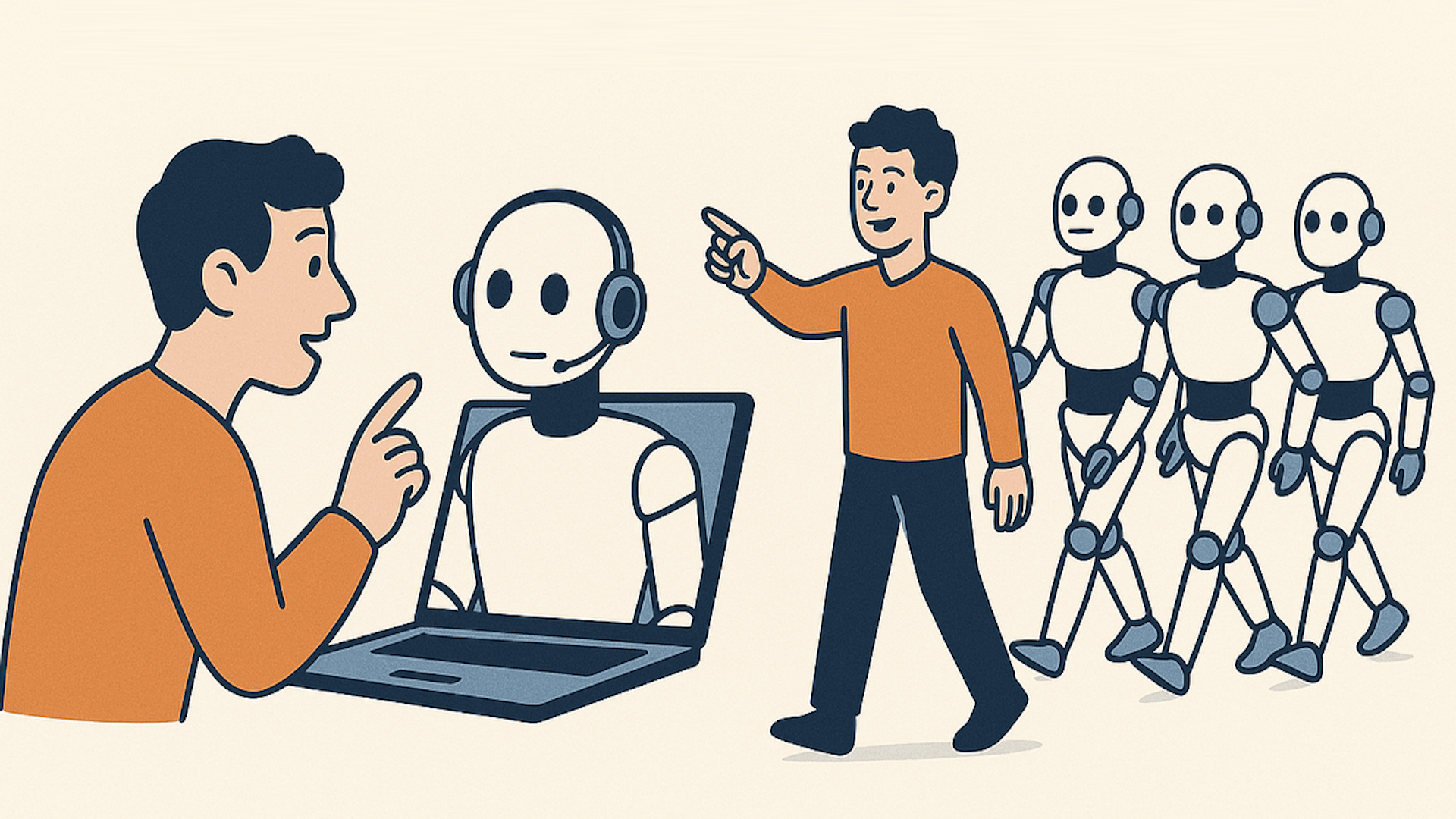
One of the easiest ways to tell a technology trend has crossed a line is this: people stop talking about what it could do and start worrying about what it’s already doing while they sleep.
That is where AI agents are landing in 2026.
Not chatbots, exactly. Not the polite little answer machines that summarize your notes or rewrite your email subject lines. AI agents are the next evolutionary jump: software that can take a goal, decide on steps, use tools, move across apps, and complete multi-step work with less hand-holding than earlier AI systems. In other words, the industry is shifting from “ask me anything” to “let me handle that.” And suddenly, everyone from Microsoft to Okta to NIST is treating this shift as something bigger than another feature release.
That’s why AI agents feel like one of the defining trends of 2026. The hype is real, yes. But so is the scramble to govern, benchmark, secure, and monetize them. Surveys from Anthropic and Google Cloud describe agents moving into production workflows, while fresh benchmarking research suggests the technology is still far from reliably autonomous in high-stakes professional work. The result is a classic modern-tech moment: enormous momentum, mixed performance, and a growing sense that the culture has already moved before the rulebook has.
From chatbot to co-worker
The most important thing about AI agents is not that they are “smarter.” It is that they are being designed to act.
That sounds obvious, but it changes the social contract between humans and software. A normal chatbot waits for you to type. An agent is increasingly sold as something that can monitor a queue, update a record, chase down a document, compare options, flag a risk, or complete a workflow. Microsoft’s March push around its Frontier suite and Agent 365 was framed around moving from experimentation to durable enterprise value, which is corporate language for: this is no longer supposed to be a toy.
Google Cloud’s 2026 reporting uses similar language, describing a move from one-off prompts to broader workflow systems. Anthropic’s 2026 State of AI Agents report likewise says enterprises are deploying agents in production, not just in sandbox demos. Even the rhetoric has changed. Last year, the dominant question was whether generative AI could be useful. This year, it is whether organizations are ready for semi-autonomous software colleagues roaming across their tools with logins, memory, and permissions.
There is something faintly sci-fi about that shift, of course. We grew up imagining talkative machines; what we got instead are digital interns with browser tabs. Less HAL 9000, more “the new operations associate has API access and needs supervision.”
Why 2026 feels different
Every big technology wave has a year when the mood changes. Not when the technology is invented. Not even when it first becomes public. When the ambient conversation changes.
For AI agents, 2026 looks a lot like that year.

Source: easyInsights
Part of it is the vendor pile-on. Microsoft is productizing agent infrastructure. Salesforce is remaking Slack around AI-heavy workflow assistance. Okta is openly talking about AI agent identity and “kill switches,” which is not the kind of phrase companies use when they think a category is niche or hypothetical. NIST, meanwhile, launched an AI Agent Standards Initiative focused on security, interoperability, and identity. Once the standards people show up, the party has moved from the garage to the convention center.
Part of it is the money. Enterprise surveys and vendor research are full of signs that organizations are trying to shift from pilot projects to operational use. Anthropic says more than 500 technical leaders were surveyed and reported measurable ROI from agent deployments. Google Cloud surveyed thousands of executives for its 2026 trends work. Deloitte’s 2026 enterprise AI report frames the broader moment as a transition from ambition to activation. The corporate world may not agree on definitions, but it clearly agrees on one thing: no executive wants to be caught flat-footed if agents become the next operating layer of office work.
And part of it is cultural exhaustion. Companies have spent years marinating in AI promises. “Copilot,” “assistant,” “generator,” “companion,” “chat.” Agents offer a new pitch that feels more concrete: not just helping you think, but helping you finish. In an era obsessed with productivity theater, that is irresistible.
The fantasy: digital workers who never get tired
You can see why executives love the idea.
An AI agent is a beautiful management fantasy. It can, in theory, operate 24/7, handle repetitive work, move fast, scale cheaply, and avoid the morale issues that come with making a human team chase administrative tasks into the night. It promises not just automation, but continuity. A workflow does not stall because somebody is sick, stuck in a meeting, or quietly updating LinkedIn.
That helps explain the surge of use cases around customer service, onboarding, internal knowledge work, coding assistance, and security operations. Microsoft is pitching agents inside work software. Google Cloud highlights end-to-end workflow orchestration. Anthropic’s report emphasizes production deployments. The story being sold is consistent across vendors: agents are not a sidecar anymore; they are becoming a layer in the stack.
There is also a deeper cultural reason this idea is resonating. Modern office work is bloated with coordination overhead: tabs, tickets, approvals, summaries, updates, duplicate inputs, scattered knowledge, and endless low-grade digital housekeeping. AI agents are attractive because they promise to absorb the invisible sludge of work. They are being marketed less as geniuses than as cleaners of operational mess.
That is why the concept feels sticky. Most workers do not need a silicon philosopher. They need something to reconcile the spreadsheet, chase the attachment, draft the first pass, and stop the whole week from disappearing into “just checking on this.”
The reality: still impressive, still unreliable
And yet the most interesting fact about AI agents right now is that the excitement is outrunning the evidence.
The clearest recent example is APEX-Agents, a benchmark released in early 2026 to test whether AI agents can handle long-horizon professional tasks in areas such as banking, consulting, law, and medicine. The key finding was not subtle: current systems still struggle badly with realistic white-collar work. In other words, the public story says “digital workers”; the benchmark says “not without supervision.”
That tension matters. It does not mean the agent trend is fake. It means we are in the familiar stage where the demos are cleaner than the deployments. Agents can be useful and still unreliable. They can save time and still require review. They can be transformational in narrow workflows and disastrous in broader ones. The danger is not that the technology does nothing. The danger is that it does just enough to tempt organizations into trusting it too early.
This is where the “AI employee” metaphor starts to wobble. A human junior hire can learn norms, be held accountable, and understand context that lives between the lines. An AI agent may look fluent while still lacking the judgment to know when a strange edge case is actually a five-alarm fire. It can sprint straight into a bad assumption with the confidence of a consultant on slide 47.
Security, identity, and the rise of the kill switch
If AI agents are the new co-workers, the industry’s next headache is obvious: who gave them the keys?
That question is suddenly everywhere. Okta’s Todd McKinnon has argued that AI agents need identity and kill switches. NIST’s initiative is focused on authentication, identity infrastructure, security evaluations, and interoperability. Google Cloud’s own ecosystem has already surfaced warnings about agent security and permissions. This is not bureaucratic overkill. It is a recognition that an agent is not just a model. It is a model with access.
And access is where the story stops being futuristic and becomes painfully ordinary.
Because every grand AI narrative eventually crashes into the same dull but decisive questions: What can it read? What can it change? What happens when it is wrong? Who notices? Who is accountable? Who shuts it off?
Those questions are why the standards conversation matters more than the product launch headlines. The history of enterprise software is full of tools that looked magical until governance caught up. AI agents raise the stakes because they are meant to act across systems, not just sit inside one interface. A bad chatbot gives bad advice. A bad agent may execute it.
This is not just a tech story. It is a work story.
The most interesting thing about AI agents may not be the software at all. It may be what they reveal about us.
For years, knowledge work has been drifting toward fragmentation: too many tools, too much context switching, too little deep time. Agents are arriving as both symptom and solution. They exist because work became modular enough to automate in pieces, but also chaotic enough that people are desperate for relief.
That is why the labor conversation around agents is more complicated than the usual “robots are coming for jobs” panic. Recent reporting on workplace impact has suggested a slower, messier reshaping of tasks rather than an immediate extinction event. That feels right. In many offices, the first real impact of agents will not be disappearing jobs. It will be disappearing task bundles — the annoying, repeatable clusters that once justified certain entry-level responsibilities or absorbed hours of mid-level staff attention.
Which raises a subtler problem: if junior workers do less grunt work, how do they learn the business? The career ladder has always relied, at least partly, on people doing tedious things until they understand the system behind them. If agents absorb the tedium, that could be wonderful. It could also create a generation of workers asked to supervise processes they never had to perform from scratch. The spreadsheet may be dead; the apprenticeship problem is not.
What happens next
The likeliest future is not one where agents suddenly replace whole departments. It is one where they spread unevenly, become normal in narrow domains first, and quietly change the texture of work long before the org chart catches up.
The winning environments will probably be the boring ones: structured workflows, clear permissions, measurable outcomes, human review, good logs. The losing environments will be the chaotic ones that treat “agentic” as a vibe and governance as an optional accessory. Or, put differently, the future belongs less to the flashiest demo than to the company that knows exactly when the machine is allowed to touch the CRM.
That may sound anticlimactic, but it is actually the clearest sign this trend is real. Truly important technologies stop being interesting in the cinematic sense and start becoming infrastructural. They move from spectacle to plumbing.
AI agents are headed that way now. In 2026, they still feel buzzy, awkward, overpromised, and occasionally uncanny. But they also feel inevitable in the way the internet once did when it was still full of broken pages and ugly interfaces. The point is not that the experience is perfect. The point is that too many institutions have already started reorganizing around the assumption that it will improve.
So yes, AI agents are trending because they are impressive. But they are sticking because they touch something deeper: our hunger to offload friction, our faith that intelligence can be operationalized, and our suspicion that the real frontier of computing is no longer software that waits for instructions, but software that joins the workflow and starts moving on its own.
The question now is not whether agents will enter everyday work. They already have. The real question is what kind of workplace we build once they do — and whether we remember, amid all the automation theater, that the hardest part of intelligence has never been action.
It has always been judgment.
Leave a Reply